


Let us be direct about what this is. If you want a different generation tool, meaning better motion, a model that handles faces properly, cheaper credits, Pibox is not that, and this article will not pretend otherwise. We do not generate video, we have no models, and swapping one canvas for another is a decision we have no stake in.
Read on if the reason you are looking is something else. In our experience a good share of people searching for an alternative are not unhappy with the output. They are unhappy with everything around it. Those are different problems and they need different fixes.
First: are you actually looking for a different generator?
Three reasons to switch that are genuinely about the tool:
The output is not good enough for the brief. Motion artefacts, faces falling apart, no control over camera movement. This is a model quality problem. Switch, or run two tools in parallel, which most teams doing volume work already do.
The cost per usable second is too high. Failed generations still consume credits. If your ratio of usable to generated is poor, a tool with better first-pass quality saves real money.
A specific capability is missing. Lip sync, a particular aspect ratio, a resolution ceiling, API access for batch work. Concrete and checkable.
For any of these, compare on the axis that matters and ignore everything else. Higgsfield, Runway, Freepik, Krea and ElevenLabs Flows all publish what they do; test with your own reference material rather than their showreels, because showreels are made by people who know the tool intimately.
Second: or is the problem what happens after generation?
The other set of reasons has nothing to do with model quality, and switching tools does not touch any of them:
- You cannot find the take that worked, so you regenerate it and pay twice
- The regenerated version is not identical, and a client who approved the first one notices
- Nobody knows what a campaign cost, broken down by scene
- The prompt that produced a look is gone, so the look cannot be reproduced next month
- A client asks where a frame came from and the honest answer is a shrug
- The final file went to a client without any history, and now nobody can continue it
If your list of grievances looks like this, a different canvas gives you the same problems with a different UI. This is worth being clear-eyed about before a migration, because migrations are expensive and this one would not fix anything.
What the canvases say about themselves
Worth reading vendor documentation rather than vendor marketing, because the docs are candid.
ElevenLabs Flows, launched in March 2026, is a node-based canvas that in their words "supports over 50 image and video models alongside ElevenLabs' Text to Speech, Music, and Sound Effects models," with real-time co-editing and comments on nodes. On automation their documentation is explicit: "Programmatic execution via API for mass creative production is planned for a future release." On version control, branching, audit trails and review or approval workflow, the documentation says nothing at all, which is a fair signal of what the product sets out to cover.
That is not a criticism. It is a product doing what it set out to do, optimising the hour you spend generating, and being plain about its edges. Higgsfield, which closed a $400M round in August 2026 at a $5.4B valuation, is similarly focused on the generation layer.
The pattern is consistent across the category, and it is a reasonable one: these companies compete on how fast they integrate the newest model. Storage, review chains and rights registries do not win that race.
The gap between canvas and edit
One consequence is worth spelling out, because it costs time on every project.
Generated material leaves the canvas as a file. The context, meaning which reference produced it, which prompt, which model version, which seed, stays behind in the graph, if it is anywhere. The file then arrives in an edit, a review round or a client folder stripped of all of it.
Everything downstream then has to reconstruct what was already known: the editor asks what this clip is, the producer asks what it cost, the client asks whether this is the approved version, and legal asks what went into it. Four questions with answers that existed an hour earlier and were discarded at export.
This is the gap. It is not a missing feature in any one canvas, it is the seam between the tool that makes material and everything that happens to material afterwards.
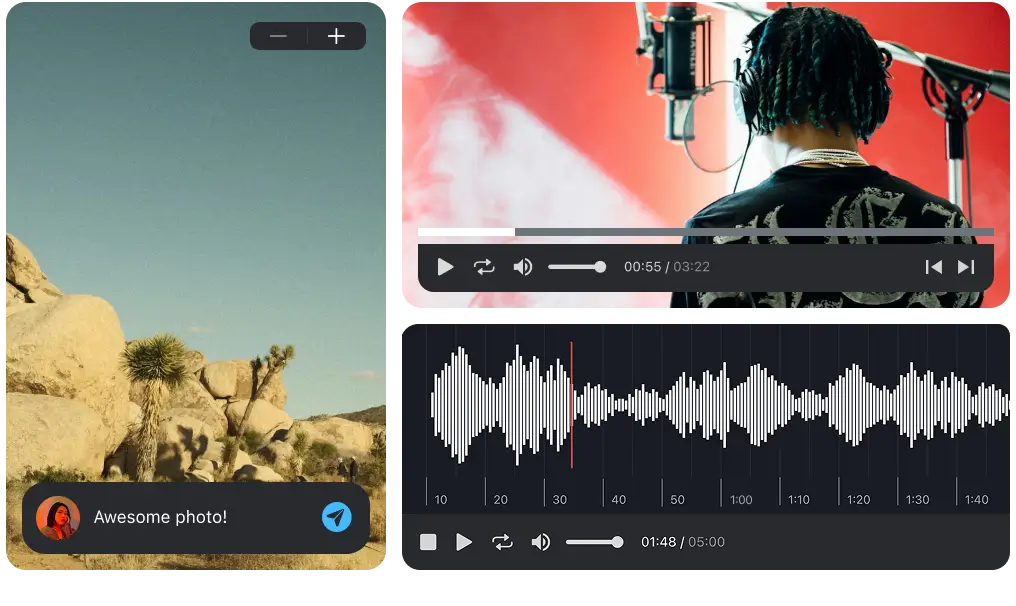
Easier, faster way to collaborate in real-time, collect feedback, manage reviews, share, and finish your projects effortlessly.
What to pair a canvas with
You do not need to replace your generation tool. You need something on the other side of that seam. What to look for:
Ingest that does not depend on the canvas exposing an API. Flows lists programmatic execution as planned rather than available. Until a canvas offers one, the practical bridge is a watch folder or a drop zone that picks up what you download.
Metadata that stays attached. Prompt, model, seed, source references, licence status of inputs. On the asset, not in an adjacent spreadsheet, because the spreadsheet is accurate for about ten days.
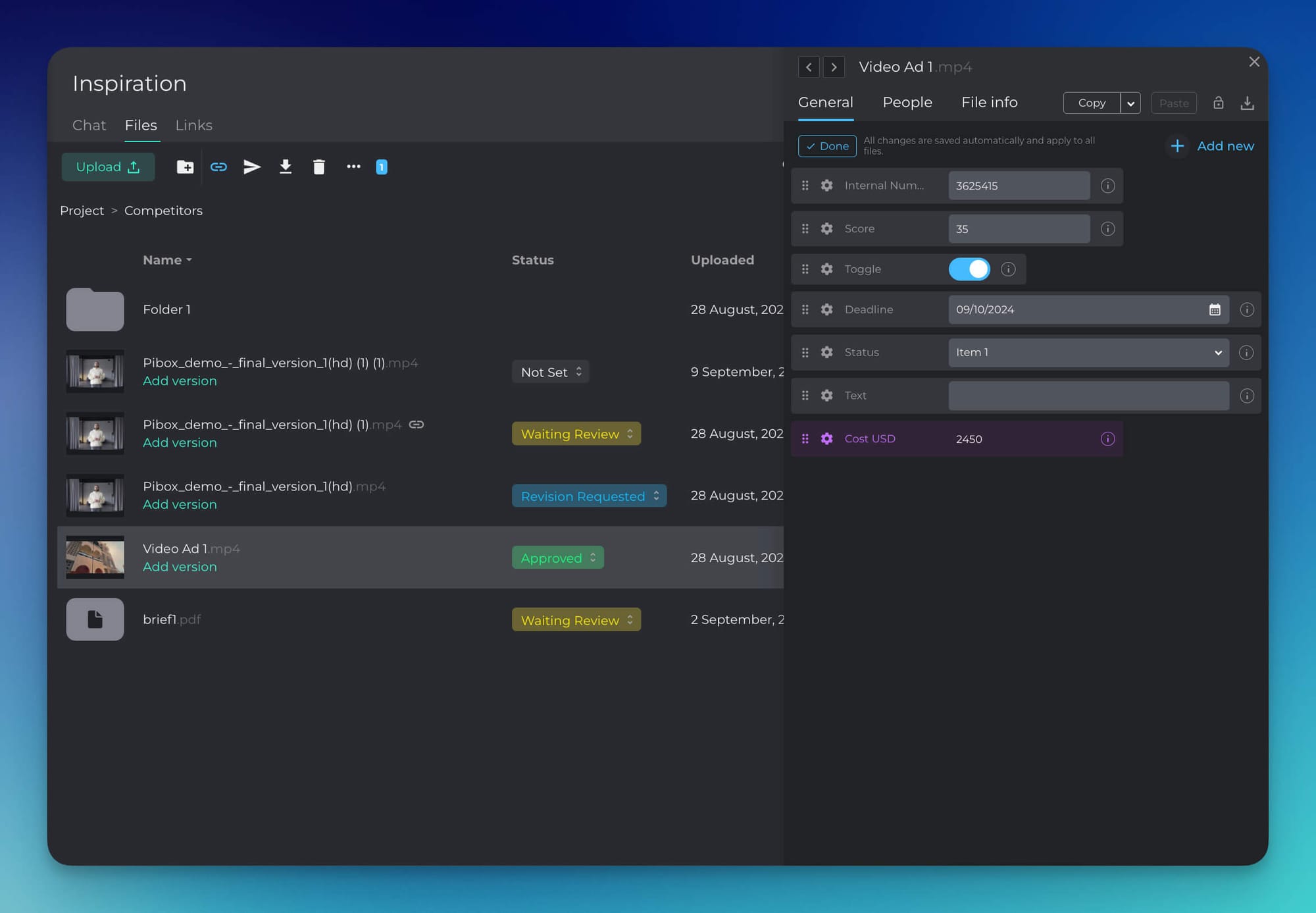
Variant-aware review. Candidates compared side by side, approval recorded against a specific variant, rejected siblings kept as the record of what was considered.
A history that outlives the project. When someone asks in nine months, the answer should be a lookup and not an excavation.
Where Pibox fits
Pibox is the layer after generation: storage with version control, metadata tagging on assets, comments tied to the moment they refer to, file status tracking through review and approval, file-request links so contributors send material in without an account, and a cross-project view of what is waiting on your review. Plugins are available for Pro Tools (AAX) and for Cubase and Nuendo (VST3) on macOS 12+ and Windows 10–11. Studios and production companies including Bleeding Fingers, Universal and Epidemic Sound use it in production.
We have no direct integration with Flows today, because running a flow programmatically is not something their API offers yet. What works now is routing downloaded output into one place with its context recorded at the same time.
For the fuller workflow picture, see an AI video workflow that survives the client call.
Create a free Pibox workspace and route one scene's worth of generated output into it. That is enough to see whether the seam is your problem.
An honest summary
If you need better generation, switch generators and ignore this article. If you need to stop losing work between generation and delivery, changing canvas will not help, and you probably do not need to change it at all.


