


The difference between amateur and professional musicians isn't always talent - it's the ability to finish. A folder full of brilliant, 80%-done demos is a common symptom of a broken workflow. The good news? It's a fixable problem.
In this guide, you'll learn:
- The exact 8-step professional workflow that transforms ideas into finished masters
- Specific strategies to eliminate bottlenecks at each production stage
- Why finishing music faster isn't about rushing - it's about removing administrative chaos
My name is Luke Mounthill. As a producer, I’ve seen many projects fall apart because of poor organization. Over time, I’ve learned that having a professional workflow isn’t about strict rules, but about having a simple, clear system.
In this guide, I’ll show you the 8-step process that successful music teams use to stay organized and release music consistently.
The real reason your songs never get finished
The "duct-tape method" is killing your productivity. You're probably juggling:
- Email for feedback
- Dropbox for file storage
- Text messages for quick questions
- Instagram DMs for project updates
This disintegrated workflow is the number one killer of creative momentum.
Here's what happens in real projects:
- Your vocalist sends stems via WeTransfer
- The mixing engineer responds with notes in an email
- Your collaborator asks arrangement questions in a text message
- You're now managing three separate conversations about one song
The result?
- Critical feedback gets lost
- File versions become confusing
- Creative energy drains away as you play administrative detective
The solution is to move from a disintegrated workflow to an integrated one. By using a single, central hub designed for creative projects, you eliminate the chaos. A platform like Pibox was built to solve this exact problem, providing the infrastructure for the professional workflow we're about to break down.

Switch and save
Make the switch from Dropbox and enjoy 20% off your Pibox subscription for as long as you stay subscribed. Just use promo code PIBOXVSREPLY20 at checkout to unlock your exclusive offer.
*Offer valid for new Pibox customers only. The promo code gives you 20% off monthly subscriptions and 30% off if you choose the annual plan.
A professional 8-step workflow for faster releases
Breaking down music production into distinct stages creates clarity and prevents overwhelm. Each stage has a specific creative goal and common bottlenecks that slow progress.
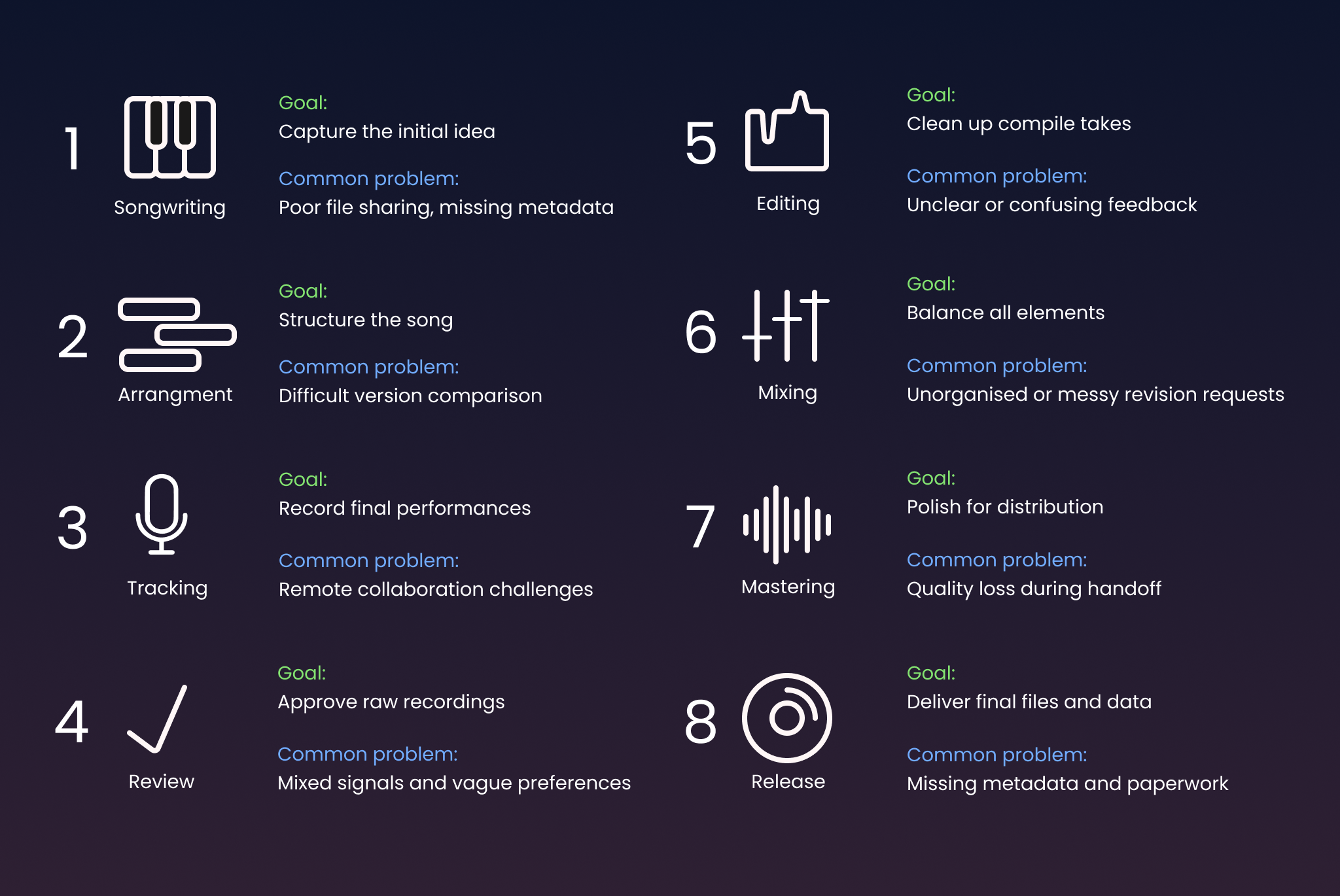
Step 1: Songwriting & composition
The goal: Capture the initial idea - the beat, the lyrics, the melody before it fades.
The biggest workflow killer: Poor file sharing that loses sonic detail and forces collaborators to ask basic technical questions.
The workflow accelerator:
Instead of emailing lossy MP3s, share high-quality WAV files through a platform like Pibox. Its AI can automatically tag your beat with essential information:
- Key signature
- BPM (tempo)
- Genre
- Instruments
- Mood
- File format and quality
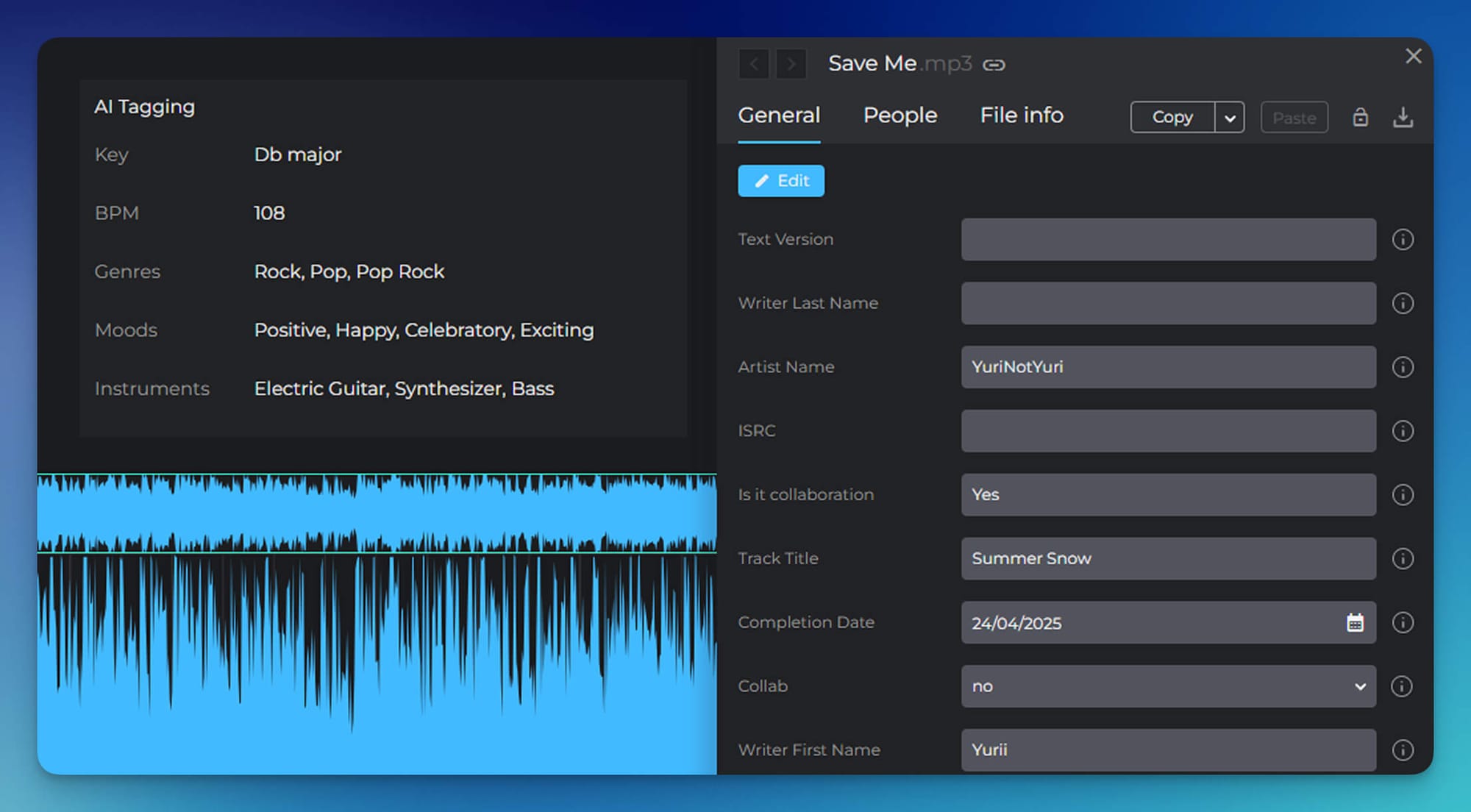
Your co-writer gets all the technical info they need instantly. They jump straight into writing without sending messages back and forth about basic track information.
Why this matters: Automatic metadata extraction saves hours over the course of a project. Your collaborator opens the file and sees "108 BPM, Db major" without asking. They start writing immediately while the creative energy is still hot.
Step 2: Arrangement (the blueprint)
The goal: Structure your song into verses, choruses, bridges, and outros. This determines the emotional journey your listener experiences.
The biggest workflow killer: Version comparison chaos. You create two different arrangement ideas but have no easy way to let collaborators switch between them.
The workflow accelerator:
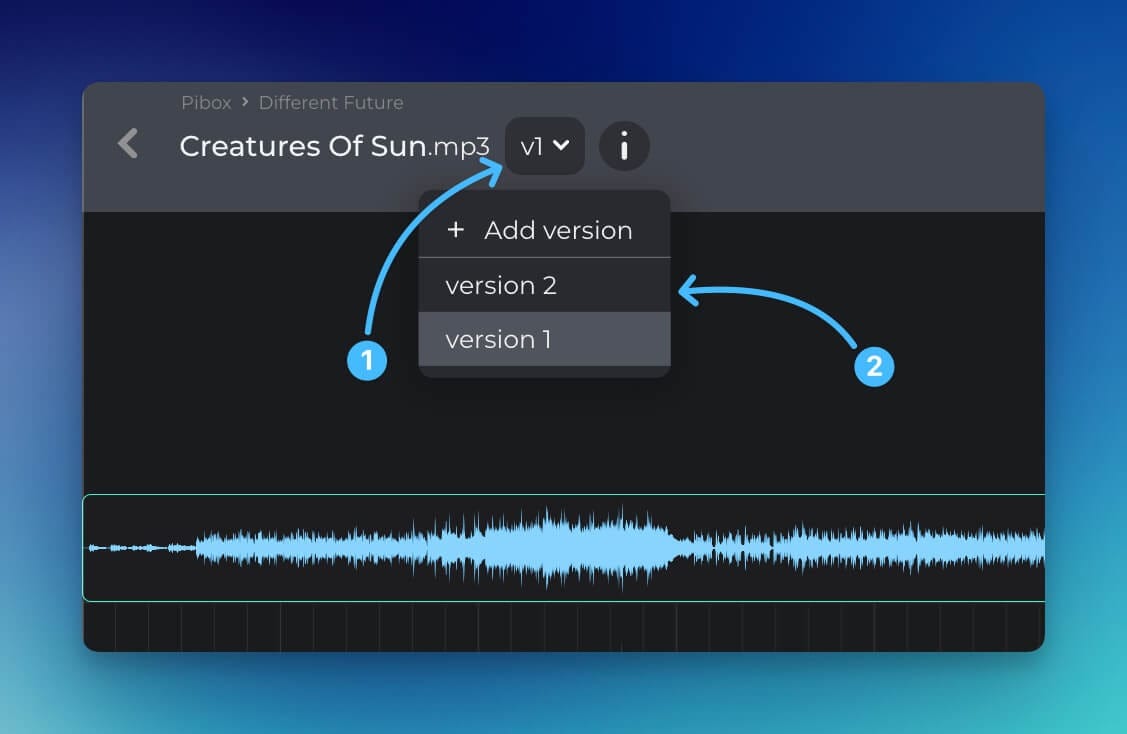
Need feedback on two different arrangement ideas? Don't send two separate files. Tools like Pibox let you link V1 and V2 together with a compare feature.
Your collaborator can:
- Switch between versions instantly
- Leave time-stamped notes like "This 8-bar intro feels much stronger"
- Reference specific sections without confusion
This side-by-side comparison makes decision-making faster and more confident. Instead of vague feedback based on memory, your team makes informed choices based on direct A/B listening.
Step 3: Tracking (the performance)
The goal: Record the final vocals and instruments. The creative vision becomes captured performances.
The biggest workflow killer: Remote collaboration challenges. Your vocalist is on tour in another city. How do you securely share the instrumental and receive high-quality stems back?
The workflow accelerator:
Share the instrumental securely via a platform like Pibox. Your vocalist can:
- Access the file from their phone or laptop
- Record their takes in any location
- Upload high-resolution stems directly back to the project
- Keep the project moving forward from anywhere
The mobile advantage: This accessibility is game-changing for modern production. Artists record in:
- Hotel rooms during tours
- Home studios between shows
- Professional facilities when available
Then they deliver stems immediately. No waiting for them to get home to upload files from their laptop.
Step 4: Review (The Quality Check)
The Goal: Check your recordings and rough layout before you start the final mix. This is your "green light" moment.
The Biggest Workflow Killer: Mixed signals. You have ten vocal takes and three guitar solos. The artist likes the feeling of Take 3 but the pitch of Take 5. Trying to explain this in an email is messy and confusing. You end up with a final track that no one is truly happy with.
The Workflow Accelerator:
Don't start editing until you know exactly what to keep. Use Pibox to make the review easy:
- Make a "To-Do" List: Set clear rules for what needs to be checked (e.g., "Check Vocals," "Check Lyrics," "Check Flow").
- Mark the Best Parts: Use comments on the timeline to highlight the wins, not just the errors. "This ad-lib at 2:14 is perfect - keep that."
- Approve Before Moving On: Use status tags to mark specific files as "Approved".
Why This Saves the Project:
A dedicated review step stops the endless changes later on. By getting a clear "yes" on the raw recordings now, you ensure the mix engineer doesn't have to fix a bad performance later. You are building on solid ground.
Step 5: Editing (The clean-up)
The goal: Compile the best vocal takes, tighten timing issues, and clean up audio problems. This stage demands precision.
The biggest workflow killer: Vague feedback that destroys the editing process. When someone texts "the timing feels off in the second verse," you're left guessing which exact syllable needs adjustment.
The workflow accelerator:
Feedback on edits needs surgical precision. Instead of vague texts, use Pibox to pinpoint exact moments:
- Click directly on the problematic syllable in the waveform
- Leave a time-stamped comment with specific instructions
- Discuss the edit in a dedicated comment thread
- Keep all feedback organized and actionable
Why this transforms editing:
Time-stamped comments on waveforms eliminate confusion. Your editor sees exactly which word at exactly which timestamp needs work. They fix it once, correctly, instead of guessing and sending multiple revisions.

Step 6: Mixing (The balance)
The goal: Blend all individual tracks into a cohesive, balanced song. Each revision cycle should move closer to the final vision.
The biggest workflow killer: The mix revision process is where projects often die. Engineers receive scattered feedback via:
- Email threads
- Text messages
- Voice notes
- Random DMs
They're forced to piece together a coherent action plan from fragmented comments across multiple platforms.
The workflow accelerator:
Every time-stamped comment becomes an actionable task in an organized checklist. As the mix engineer, you get:
- A clear, prioritized list of revisions
- Specific instructions instead of vague requests
- All feedback in one central location
- The ability to deliver new mix versions in hours instead of days
Before vs. after:
| Old Way | New Way with Centralized Workflow |
| "I think the vocals could be louder and maybe the hi-hats too?" (scattered across 3 platforms) | "Vocal level +2dB at 1:23" (organized in single interface) |
| Engineer spends 2 hours decoding feedback | Engineer starts work immediately with clear instructions |
| 5-7 day revision turnaround | 1-2 day revision turnaround |
Step 7: Mastering (The polish)
The Goal: Prepare your final mix for distribution with competitive loudness and tonal balance. This is the final creative step before release.
The biggest workflow killer: Quality loss at the handoff point. Artists bounce their mix and send it via email or basic file transfer services. Compression artifacts sneak in. The mastering engineer works with degraded audio.
The workflow accelerator:
Ensure quality isn't lost at the final step:
- Deliver your high-resolution final mix via a secure link
- The mastering engineer uploads the final master to the same project
- You A/B compare the unmastered and mastered versions
- Approve changes before final sign-off
The A/B comparison advantage: You toggle between the unmastered mix and mastered version, hearing exactly what the engineer changed. This prevents surprises and ensures the master matches your vision.
Step 8: Release & delivery (The finish line)
The goal: Gather all necessary metadata and deliver final files to your distributor. This administrative stage shouldn't be creative, but it often becomes chaotic.
The biggest workflow killer: Scattered information collection. You need:
- ISRCs from one person
- Songwriter splits from another
- Publisher info from a third collaborator
- Featured artist details from someone else
Collecting this data via separate emails creates massive delays as you chase people for missing information.
The workflow accelerator:
Don't get delayed by missing paperwork. Use metadata forms to collect all essential release info from your collaborators directly within the project:
- ISRCs and UPCs
- Songwriter split percentages
- Publisher information
- Featured artist details
- Production credits
- Explicit content flags
Why this saves your release:
When it's time to release, all your data and your final master are in one organized, secure place. You see at a glance what's complete and what's missing. You can follow up on specific gaps instead of sending blanket "did everyone send everything?" messages.
The secret to a faster workflow isn't rushing - it's clarity
Finishing music faster isn't about rushing the creative process. It's about eliminating the administrative friction that constantly slows you down.
When you reduce time spent on:
- Hunting for files across different platforms
- Decoding vague, scattered feedback
- Managing conversations across multiple apps
- Chasing collaborators for missing information
You increase time spent on:
- Actual music creation
- Creative decision-making
- Artistic refinement
- Consistent releases
The 8-step workflow provides the framework. A central hub like Pibox provides the infrastructure to execute that framework efficiently. Together, they replace chaos with clarity.
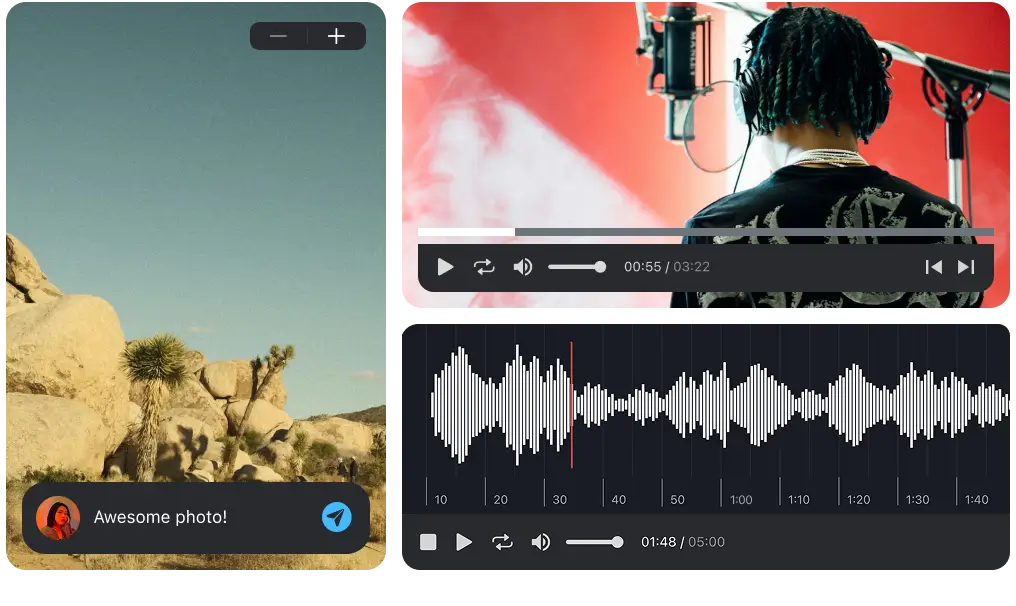
Easier, faster way to collaborate in real-time, collect feedback, manage reviews, share, and finish your projects effortlessly.
Why this system compounds over time
This systematic approach gets better with every project:
- Project 1: You notice immediate improvements in organization
- Project 5: You're finishing songs in half the time
- Project 10: The system runs on autopilot, protecting your creative time
Professional producers don't have more hours in the day. They have better systems that protect their creative time from administrative waste.
Your action plan: How to implement this workflow today
Start by mapping your current process:
- Identify which of the 8 stages takes the longest in your projects
- Pinpoint where you lose the most time to administrative tasks
- Focus on fixing your biggest bottleneck first
Common bottlenecks to address:
- Mix revision chaos? Centralize feedback in one platform
- Tracking handoff delays? Implement secure, direct file sharing
- Release paperwork nightmares? Use standardized metadata collection forms
Build your system incrementally:
- Week 1: Document your current workflow
- Week 2: Choose one stage to optimize
- Week 3: Test the improvement on a real project
- Week 4: Refine and expand to the next stage
The goal isn't perfection on day one. The goal is building a repeatable system that improves with each project. Share your workflow with collaborators so everyone knows the process. This consistency transforms occasional releases into a sustainable creative practice.
If you're ready to stop juggling and start creating, it's time to try a workflow built for musicians. Explore how Pibox can streamline your next project.

Pibox is the easier, faster way to collaborate in real-time, collect feedback, manage reviews, share, and finish your projects effortlessly.
Frequently asked questions about music production workflows
What is the most important stage of music production?
While every stage is crucial, many producers agree that the Songwriting & Composition stage is the most important. A great song idea with an average mix can still be a hit, but a perfect mix of a bad song idea will always fall flat. A good workflow protects that initial creative spark above all else.
How long should it in take to finish a song?
There's no single answer, but a professional team with a streamlined workflow can often finish a song in one to two weeks. The real goal isn't just speed; it's consistent momentum. A great workflow prevents the long, frustrating delays that come from simple disorganization.
Can I mix and master a song at the same time?
No, and this is a key difference between amateurs and pros. Mixing involves balancing all the individual tracks, like your vocals, drums, and bass. Mastering is the final polish applied to that single, finished mix file. Always complete your mix first, then export it before you even think about mastering.
Do I need expensive plugins to have a good workflow?
Absolutely not. A clear system is far more important than expensive tools. The principles of organization and clear communication will make you a faster producer, even with the stock plugins that came with your software. A platform that organizes your process will have a bigger impact on your speed than a new plugin will.


